

If you manage a business, you have probably encountered some version of the same operational problem: timesheets arrive in five different formats and someone spends hours every week re-entering them into the payroll system. Purchase orders sit in email attachments. Customer intake forms still arrive on paper. Information moves between teams through spreadsheets, inboxes, and manual handoffs because the systems involved were never designed to work together.
These problems exist across industries, and the natural response is often to look for newer, more sophisticated technology to solve them. AI promises to automate processes, connect information, and eliminate much of the manual work. But AI cannot compensate for operational foundations that are fragmented, inconsistent, or overly dependent on people.
Before deciding where AI can create value, organizations need to understand where they are starting from. The maturity of your existing processes, systems, data, and integrations will influence what you can realistically achieve with AI and how quickly you can get there.
We call this your AI Readiness score. It helps identify where your organization sits today and, more importantly, what needs to happen before AI can deliver meaningful results.
Your AI readiness score
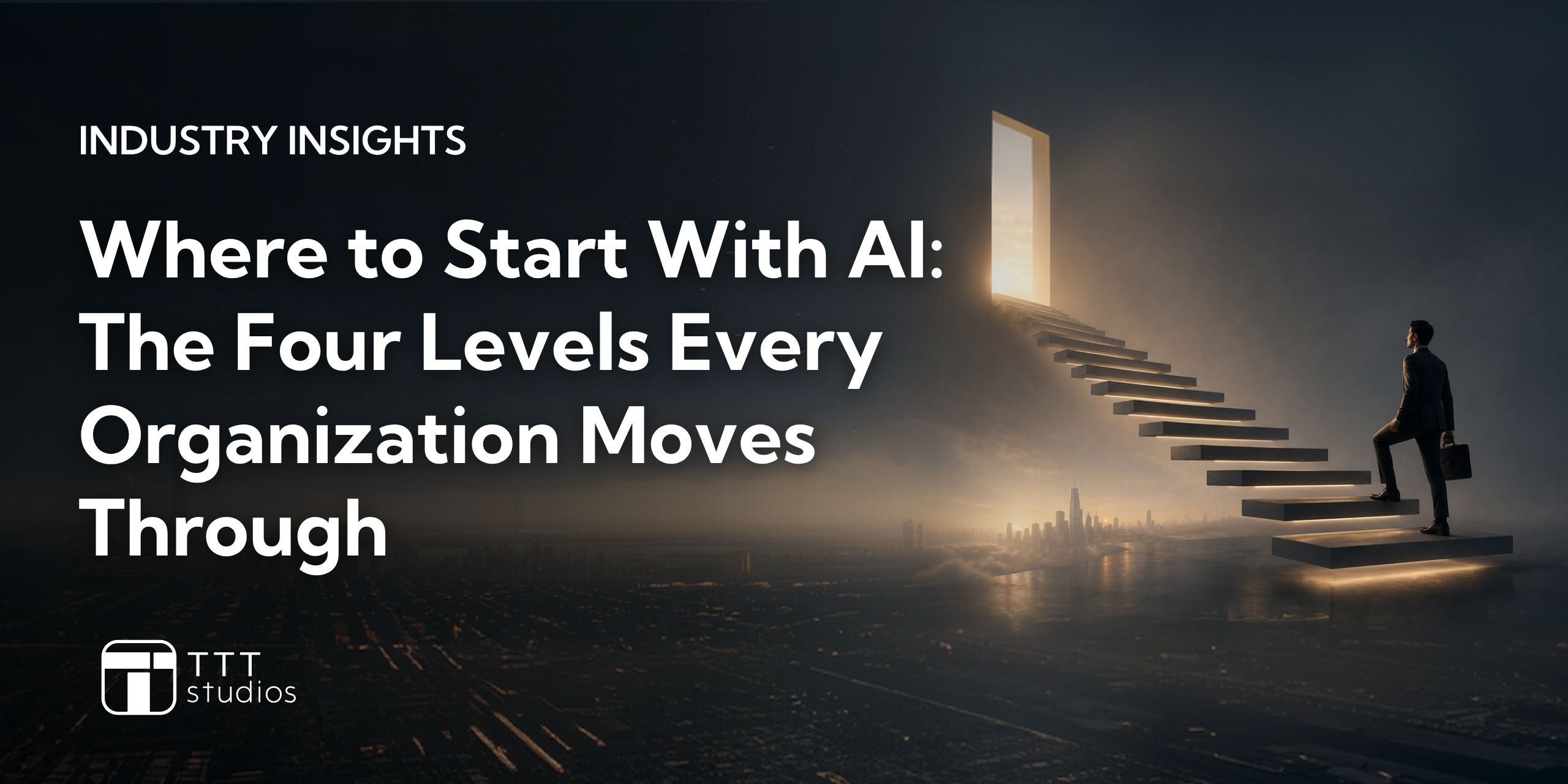
Organizations tend to fall into one of four levels of operational AI readiness. Each level reflects what the business can realistically accomplish with the processes, systems, data, and integrations it has in place today.
Your current level determines what you should build next, and what is better left alone for now. An AI solution that works well in a Level 3 environment may have little chance of succeeding at Level 1, simply because the underlying data and processes are not consistent or accessible enough for it to work with.
The idea of assessing technological and AI maturity is well established. Frameworks such as acatech’s Industrie 4.0 Maturity Index, Monica Rogati’s AI Hierarchy of Needs, and MITRE’s AI Maturity Model take different approaches to assessing the capabilities organizations need as they progress toward more sophisticated use of technology and AI. These frameworks provide useful perspectives, particularly for technology leaders and centralized AI teams.
But there is another question that is often more useful to the people responsible for getting work done: Is the operation itself ready for AI?
That is the focus of our framework. Rather than assessing your overall AI strategy or organizational maturity, it looks at the operational foundation AI depends on: how work moves through the business, where information lives, how systems interact, and how much of the process still depends on manual intervention.
Because it focuses on the systems and workflows already in place, the assessment can be answered by the person who owns the operation. The result is practical: it tells you what your operation can realistically do with AI today, what to prioritize next, and where introducing AI too early is likely to create more complexity than value.
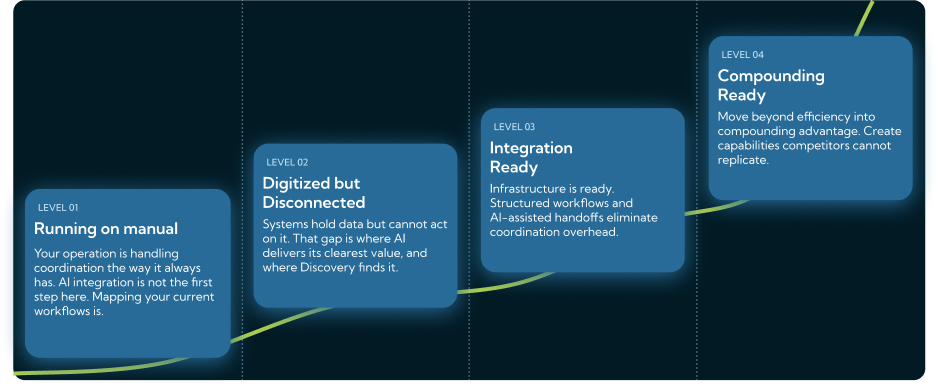
Level 1: Running on manual
At this stage, coordination happens through phone calls, paper, photographs, and email. The data lives in people’s heads and inboxes. There is no structured record of the work as it happens, only a reconstruction of it afterward.
A construction group we work with was operating this way across 22 active sites. When a superintendent needed material, he called the supplier and placed the order by phone. Accounting often did not find out until the invoice arrived a month later. The team then had to work backwards to determine who ordered the material, which site it was for, and which budget it belonged to. Roughly 90% of purchase orders were being created after the fact.
Ordering is simple in isolation, but multiply it across 22 sites, several hundred orders a week, and a different manager at each site, and the process quickly becomes difficult to control. There is no AI solution to apply at this stage because the underlying order data does not exist in a structured, accessible form for a system to work with.
The first move at Level 1 is therefore data capture. To work effectively, that capture step needs to fit into the tools and workflows people already use. A superintendent has a phone in his pocket and his hands full. The same is true of a nurse between patients or a technician standing in a mechanical room. Anything that requires a laptop, a separate login, or a new workflow is likely to be bypassed. The manual phone call to the supplier will continue.
What we built was an app in Microsoft Teams. The superintendent describes the order in the channel, a completed purchase order is generated, and the information is written back to the ERP. Retroactive POs dropped from 90% to 25%, while Accounting recovered 20 to 33 hours a month.
At Level 1, the goal is not to automate the entire process with AI. It is to create a reliable digital record of the work as it happens. Once that foundation exists, more sophisticated automation becomes possible.
Level 2: Digitized but disconnected
At this stage, the data sits in systems, but those systems cannot talk to each other, so people move information between them manually.
Many mid-market operations today are somewhere around this stage, and it can be one of the most expensive places to operate. The cost is spread across many people and many small tasks, so it rarely appears as a line item anyone can easily identify. A local manufacturer we worked with was losing 20 hours a week to order processing alone. Orders arrived by email, someone read them and entered them into the ERP, then checked them against a pricing document stored somewhere else. Each system did its job, but a person was still required to move the data between them.
Level 2 is also where individual AI tool use starts to appear. A tech-savvy employee might paste an order into ChatGPT to extract the line items. Someone else might write a different prompt for the same task. Both may get a usable answer, but neither approach produces a consistent process. The workflow now has as many variations as there are people performing it.
At our manufacturing client, several employees were using AI tools effectively on their own. But because each person was using different prompts, the outputs varied. That variability contributed to a production mistake that cost the company thousands of dollars. The initial instinct was to blame the AI model, but the underlying problem was the process. When every person uses a different prompt, the output can vary from one interaction to the next. The quality of the result ultimately depends on who happens to be responsible for the production flow that day.
Managing this variability requires turning an individual technique into a repeatable, unified process. The organization needs to decide in advance which steps should be handled by a system, where AI can assist, and where human oversight is required.
The opportunity at Level 2 is data connection. Something needs to carry information across the gaps between the systems you have already paid for, while people shift from manually producing the output to reviewing and managing it.
Level 3: Integration-ready
At this stage, data is already flowing from shared sources and workflows are structured. The focus shifts from connecting systems to improving how work is coordinated across teams.
A national healthcare nonprofit we worked with had years of operational data stored across Microsoft systems. The Level 3 work was connecting that data and building automations within the environment they already had. There was no new platform to introduce, no migration to manage, and no need to retrain staff on unfamiliar software. After we implemented targeted automations within the organization’s existing Microsoft ecosystem, processing capacity increased by 45% with the same team.
The key at Level 3 is prioritization. At the first two levels, the next step is relatively clear because there is usually a fundamental constraint blocking progress. At Level 3, the foundation is strong enough that several opportunities become viable at once. The challenge shifts from making the data usable to deciding which capability the business needs first, where the supporting data should live, and how the work should be sequenced.
Level 4: Compounding
At Level 4, the data generated across the operation becomes a source of new capabilities that competitors cannot easily replicate. The value is no longer simply a faster workflow. It is the ability to make a decision the business could not make before because the data to support it did not exist in a usable form.
A precious metals investment client we worked with reached this level through a multi-stage engagement. They wanted to forecast the productive life of the assets in their portfolio, but the data needed to do that was arriving from multiple sources in inconsistent formats.
The first stage was simply making that information reliably available. The next was creating a consistent structure so the data could move between systems. At Level 3, the data became standardized and trustworthy enough for the team to use without manually checking every record. Only then could we build the forecasting capability they originally wanted: a life-of-mine model that uses production data to forecast how long each mine is likely to remain productive.
The important point is that the Level 4 capability was not a standalone AI solution. It was the result of everything that came before it. The forecasting model could not have been built effectively at Level 1 or 2, regardless of the technology or budget available. The foundation had to be built first.
That progression is why organizations should be skeptical of vendors promising Level 4 outcomes for operations that are still at Level 1 or 2. The outcome may be real, but there is no shortcut to the foundation. The capability has to be built one stage at a time.
How to tell which level you are on
Identifying your current level before you scope anything is one of the simplest ways to reduce risk on an AI project. It removes work that was never going to succeed from the plan before money is committed.
A Level 1 or Level 2 operation that buys a Level 3 solution gets a tool it cannot use effectively. The underlying data is inconsistent, nobody trusts the output, and adoption stops within a quarter. The license fee is recoverable. The harder cost is the year that passes before anyone internally is willing to approve a second attempt.
A quick diagnostic to get you started
Pick one process people complain about and answer three questions about it.
- Is there a record of this work created as it happens, or is it reconstructed afterward from email and memory?
- Do your systems pass information to each other, or does a person move it between them?
- If the one person who runs this left tomorrow, what would happen?
Answer these questions by watching the work rather than simply asking about it. People tend to describe the process they were trained on. The version they actually perform often contains extra steps that only appear when you are standing there, and those steps are usually where the friction is.
The last question is especially important. A process that only one person can run has no reliable record of itself, which puts it at Level 1 regardless of how much software sits around it.
Determine your AI-readiness before you build
Most quotes for AI work arrive before anyone has mapped the process. A fixed price in week one assumes the scope is already known, but at Level 1 or Level 2, it usually is not. That is why Discovery comes first at TTT Studios. We map the workflow, the systems it touches, and the people who need to adopt it. The steps that require engineering get engineered. The ones that require judgment keep a person in the process. The build is then scoped from what the discovery produces.
The faster version is our AI readiness assessment. In two minutes, it identifies your position on the curve and the next move available to you.
Frequently Asked Questions
Sources
- acatech, National Academy of Science and Engineering. Industrie 4.0 Maturity Index: Managing the Digital Transformation of Companies, Update 2020. Munich, 2020.
- Rogati, Monica. The AI Hierarchy of Needs. HackerNoon, 2017.
- MITRE. The MITRE AI Maturity Model and Organizational Assessment Tool Guide. 2023.
- Performance figures in this post are client outcomes. Client names are withheld and described by industry.
.png)